The $12 Billion Problem Alberta Just Started Fixing
Alberta Innovates is investing more than $14 million in shared infrastructure across semiconductors, defence, and agri-food — and attracting nearly $48 million in partner contributions in the process. The real story isn’t the funding. It’s what happens when a province decides to stop watching its best ideas leave.
Where Did $12 Billion Go
Somewhere in 2025, a project that could have broken ground in Alberta didn’t.
It didn’t fail on its merits. It didn’t run out of capital. It was reviewed by Alberta’s regulators — a process that already involves environmental assessment, engineering scrutiny, Indigenous consultation, and public comment — and then reviewed again by Ottawa. Same project. Different forms. A second clock running on top of the first one.
At some point, the math changed. The timeline got long enough, and the outcome uncertain enough, that the capital found somewhere else to go. Texas, maybe. North Dakota. Somewhere the answer came back in months instead of years.
The cumulative cost of that friction, in 2025 alone, was $12 billion in energy investment that chose the US over Canada.
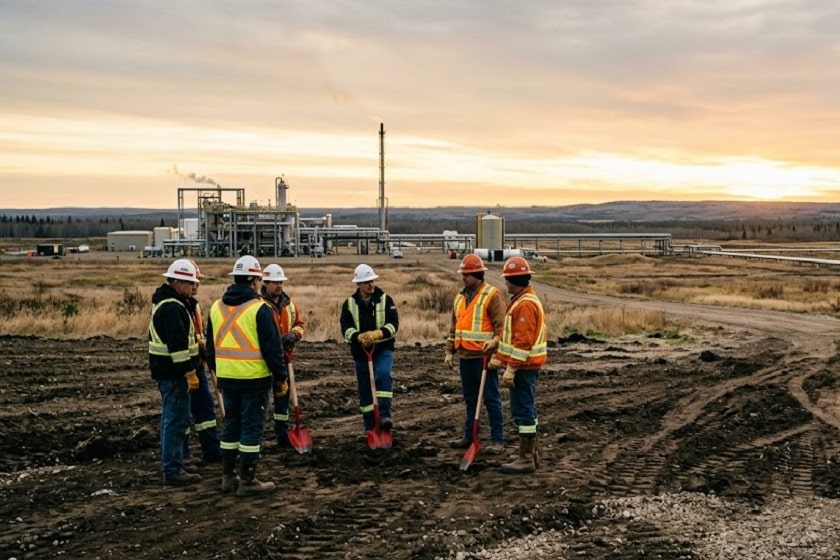
That’s not a policy abstraction. That’s a pipeline inspector in Red Deer who didn’t get the call. An electrical contractor in Edmonton who watched a project get shelved. A welding crew in Grande Prairie that spent another season waiting.
So What Actually Changed
In March 2026, the governments of Canada and Alberta reached an agreement-in-principle that does something straightforward: for projects within provincial jurisdiction, Ottawa will recognize Alberta’s environmental and regulatory review as sufficient. One process. One timeline. The federal layer steps back.
By April 2, the cooperation agreement was signed. By April 14, Alberta had introduced Bill 30 — the Expedited 120-Day Approvals Act — setting a hard clock on major project decisions. Projects need to meet a threshold: at least $250 million in capital investment, strategic economic importance, alignment with provincial priorities. When cabinet designates a qualifying project, regulators have 120 days to approve or reject it.
Adam Legge, president of the Business Council of Alberta, called the agreement a meaningful shift. “This puts decision-making squarely where it belongs — with the Government of Alberta,” he said. “It will help reduce approval timelines, create greater certainty, and improve conditions for investment in the province.”
That last phrase — conditions for investment — is the one worth sitting with. Because what investors need, more than almost anything else, isn’t a guaranteed yes. It’s a guaranteed answer.
A Groundbreaking in Oil Country
On June 2, Bitdeer Technologies broke ground near Fox Creek on a $214 million facility pairing a 101-megawatt natural gas plant with roughly 100 megawatts of computing capacity. Three hundred construction jobs. Thirty permanent positions. Priority hiring for Alberta contractors and local workers, including entry-level roles for new graduates.
Jihan Wu, Bitdeer’s CEO, was direct about why Fox Creek won. Alberta offered “regulatory confidence, openness to industrial investment, energy resources, and a skilled workforce that projects like ours require.”
That project moved through years of permitting under the old system. What the new agreement changes is what comes next — the facilities still in the queue, the developers still doing the math on whether Alberta’s timeline is workable.
Alberta is on track to host roughly 90% of Canada’s planned hyperscale data centers. Alberta’s Best has been tracking that buildout — the eStruxture campus going up in Rocky View County, the AHI Hub accelerating near Red Deer, the broader wave of AI infrastructure investment that’s been choosing this province over every other option in the country. All of it depends on projects clearing regulatory hurdles on a timeline that investors can actually plan around.
Faster approvals don’t just help energy projects. They’re the foundation the entire buildout runs on.
Same Trades, Different Morning
A town that built itself on oil and gas just watched a groundbreaking for a facility that runs natural gas through a power plant to feed an AI computing campus. The crew showing up there this summer will include electricians, pipefitters and civil contractors — the same trades that have always built things in northern Alberta.
The work looks familiar. What it’s powering is different.
Alberta was losing $12 billion to a process problem. The province now has an agreement, a signed cooperation framework, and a 120-day clock. Whether that’s enough to bring some of that capital back depends on execution. But the conversation has shifted from why projects stall to how fast they move.
That’s a different conversation to be having.
Sources
Alberta Innovates — Alberta Innovates invests more than $14 million alongside partners to strengthen Alberta’s innovation ecosystem
https://albertainnovates.ca/news/alberta-innovates-invests-more-than-14-million-alongside-partners-to-strengthen-albertas-innovation-ecosystem/
Digital Journal — Alberta Innovates backs shared infrastructure with $14 million
https://www.digitaljournal.com/article/alberta-innovates-backs-shared-infrastructure-with-14-million/
EE Times — Canada Exploits Telecom Heritage for Compound Semiconductors
https://www.eetimes.com/canada-exploits-telecom-heritage-for-compound-semiconductors/
BetaKit — At Olds College Smart Farm, everything is new
https://betakit.com/at-olds-college-smart-farm-everything-is-new/
GN Corporations — About
https://www.gncorporations.com/about
