What Happens When Alberta Invests in Its Own Ideas?
Alberta Innovates is investing more than $14 million in shared infrastructure across semiconductors, defence, and agri-food — and attracting nearly $48 million in partner contributions in the process. The real story isn’t about funding, its about what happens when a province decides to stop watching its best ideas dissappear into other countries.
Alberta has a habit of growing things and watching them leave.
Micralyne, an Edmonton manufacturer of MEMS sensor chips, was bought by American conglomerate Teledyne. Ontario’s ATI became California’s AMD. Vancouver-born PMC-Sierra was acquired by Skyworks. The pattern isn’t unique to Alberta — it runs across the country — but the province has felt it in sectors it cares about.
Oil patch expertise is exported through acquisitions. Agricultural IP developed here and commercialized elsewhere. Engineering talent that leaves for better-funded environments and doesn’t come back.
That familiar model changed when Alberta Innovates announced more than $14 million in new funding to strengthen the province’s innovation ecosystem. The announcement covers three distinct streams — semiconductor infrastructure in Edmonton, a defence and dual-use province-wide initiative, and an agri-food commercialization pilot running through four southern Alberta colleges.
The $14 million pulled in nearly $48 million in additional partner contributions. That ratio is worth holding onto.
What the Money Is Buying
The investment isn’t going to companies. It will be used by infrastructure companies.
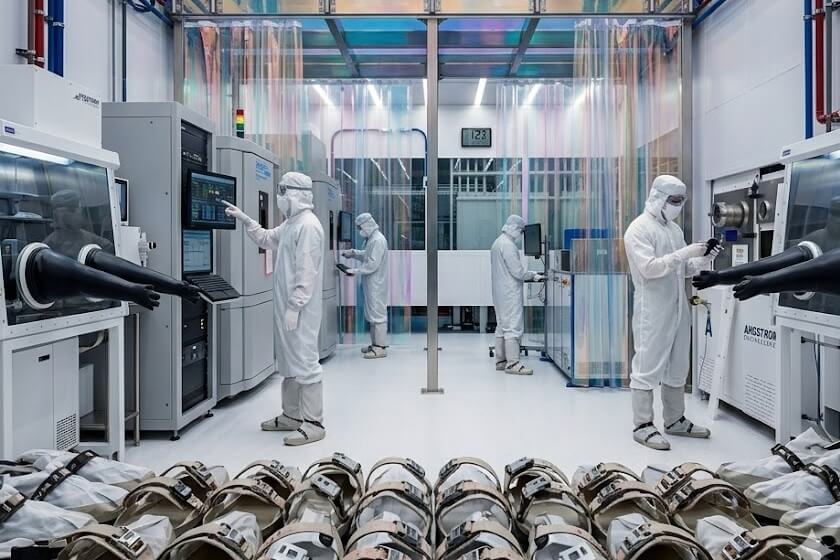
The NanoFAB at the University of Alberta is an open-access fabrication facility — semiconductor equipment that no startup could afford on its own, now it’s available to any company that needs it.
DEFENDS, the defence initiative led by the University of Alberta, provides small and medium-sized businesses with access to secure testing environments and specialized research facilities for work on autonomous systems and advanced manufacturing.
The agri-food pilot, led by Lethbridge Polytechnic alongside Lakeland College, Olds College, and Medicine Hat College, is building a pathway that connects companies with applied research expertise they can’t employ full-time.
The shared infrastructure model matters because of what it replaces.
Without the NanoFAB, a semiconductor startup in Edmonton would either need to build its own fabrication line — which is not realistic — or outsource to facilities in Taiwan or Singapore. The latter is how Canada has historically handled it. The company stays Canadian in name; the manufacturing goes somewhere else.
Vallen Rezazadeh came back from IBM in New York specifically because the NanoFAB existed. He founded TransEON in Edmonton in 2019, building specialized gallium nitride chips for telecom, defence, and automotive applications.
“Without it,” he says, “TransEON and numerous other Alberta companies would not be able to develop and manufacture cutting-edge made-in-Canada semiconductor chip products for customers around the world.”
The Defence Question
GN Corporations started as a two-man machine shop in 1965 — George and Nick’s Machine Works, serving the oil patch. John Pleša now runs the company his father built, from a 115,000-square-foot facility in Airdrie. The business has been navigating the shift from resource-sector work toward aerospace and defence contracts for years.
Ottawa released its Defence Industrial Strategy in February, with a target of 70 per cent of federal defence contracts going to Canadian companies within a decade.
Whether Alberta manufacturers end up embedded in those supply chains or watching contracts flow to central Canada depends partly on whether they have what the DEFENDS program is gearing up to provide — access to secure testing facilities, research partnerships, and a path from prototype to procurement.
“A strong Canada requires strong provinces,” Pleša says. “DEFENDS reinforces Alberta’s role in building domestic capability, supporting sovereign control over critical technologies, and embedding Alberta manufacturers into long-term defence programs.”
South of the Edmonton Corridor
The agri-food pilot is the piece of this announcement that tends to get less attention, which is probably backward.
Alberta’s agriculture sector is large and well-established, yet increasingly at risk of the same export dynamics that have affected other industries.
Research and development in precision agriculture has consolidated within global companies that view Canada as a relatively small consumer market. The technology is developed for larger markets and adapted for Canadian conditions, rather than built here in the first place.
Todd Ormann, who leads external relations and research at Olds College and has tracked the ag-tech sector through stints at Syngenta, UFA, Farmers Edge, and TELUS Agriculture, has said the problem plainly: “For Canada to be sovereign and competitive, you’ve got to start sometimes with just what’s needed right here.”
The agri-food pilot is an attempt at exactly that — a commercialization pathway that pairs agri-food companies with applied research expertise at institutions that know Alberta soil, Alberta weather, and the Alberta market. If it works, the model naturally scales to other sectors.
The Leverage Number
Fourteen million dollars becomes $48 million. That’s the headline buried inside this announcement.
Innovation funding that attracts three times its value in partner contributions is doing something different from a grant program. It’s functioning as a signal — that the infrastructure is real, that the partnerships are credible, that there’s something here worth betting on alongside.
PrairiesCan, Farm Credit Canada, the Canadian Foundation for Innovation, and Alberta’s post-secondary institutions all came in as partners. That doesn’t happen around projects with weak fundamentals.
Rezazadeh has been direct about what the alternative looks like. “We’re at risk of losing tons and tons of human capital,” he said earlier this year. “Now that the United States has injected money into their semiconductor industry, that brain drain is just going to get worse.”
The $48 million says some people believe it’s worth keeping things in Alberta.
Sources
Alberta Innovates — Alberta Innovates invests more than $14 million alongside partners to strengthen Alberta’s innovation ecosystem
https://albertainnovates.ca/news/alberta-innovates-invests-more-than-14-million-alongside-partners-to-strengthen-albertas-innovation-ecosystem/
Digital Journal — Alberta Innovates backs shared infrastructure with $14 million
https://www.digitaljournal.com/article/alberta-innovates-backs-shared-infrastructure-with-14-million/
EE Times — Canada Exploits Telecom Heritage for Compound Semiconductors
https://www.eetimes.com/canada-exploits-telecom-heritage-for-compound-semiconductors/
BetaKit — At Olds College Smart Farm, everything is new
https://betakit.com/at-olds-college-smart-farm-everything-is-new/
GN Corporations — About
https://www.gncorporations.com/about
