Alberta Industry Can’t Get Efficient Fast Enough
A federal program designed to help Alberta’s factories, processors, and manufacturers cut energy costs ran out of room in under a year. The waitlist is growing. More money has just arrived. It still probably won’t be enough.
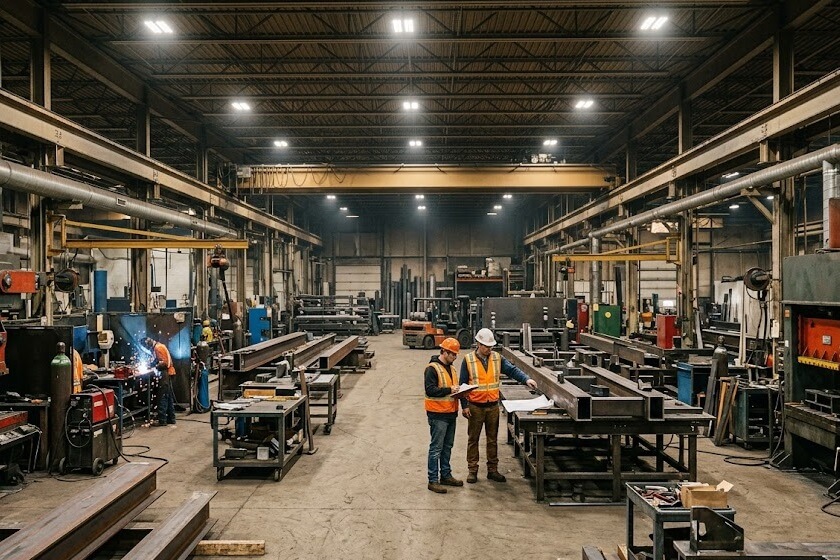
Every week, Southland Trailers ships more than 300 trailers out of Lethbridge. Six facilities, 550 people, steel dump trailers and flatdecks headed to dealer networks across Western Canada and into the US. It’s a big operation, built over four decades by a husband-and-wife team and now run by their three sons.
It is not, on the surface, the kind of company you’d expect to be deep into an energy audit and a year-long strategic energy management training program.
But that’s where Ashton Ervin, Southland’s Manager of Maintenance and Asset Reliability, found himself in late 2024. The company had applied for the Strategic Energy Management for Industry (SEMI) program, run by Emissions Reduction Alberta, and what started as an interest in solar panel funding turned into something broader.
The facility readiness assessment flagged their air compressor systems, the ones that blast compressed air to clean assembled trailers before painting. It’s an easy thing to overlook. On 300 trailers a week, it adds up fast.
“SEMI has opened a window to what’s possible for our facilities,” Ervin said.
That window is what this story is actually about.
A Program That Filled Up Fast
SEMI launched in October 2024 with $50 million behind it — $40 million from Natural Resources Canada and $10 million from the Government of Alberta through the TIER fund. The mandate was straightforward: help Alberta’s industrial and manufacturing facilities get leaner on energy, cut operating costs, and reduce emissions. Audits, energy management systems, training, and capital retrofits — up to $1 million per facility for eligible projects.
By September 2025 — less than a year after launch — the strategic energy management training stream was fully subscribed and closed to new applicants. Not paused. Closed. The waitlist opened the same day.
Justin Riemer, CEO of Emissions Reduction Alberta, put it plainly when the federal government announced an additional $10 million top-up this week: demand has exceeded all expectations, and there is a growing list of facilities waiting for funding to become available.
More than 250 facilities have now used the program. Over 500 projects. Completed work has already saved 172,000 gigajoules of energy and cut emissions by 5,000 tonnes annually. Companies have saved $2.4 million in combined operating costs.
Those are not preliminary projections. Those are results from work already done — and the program still has more than a year left to run.
Who’s Actually In Line
The face of SEMI isn’t what the skeptical version of this story would expect.
Yes, oil and gas are in the mix — about 20% of projects. But the majority is manufacturing. Southland Trailers in Lethbridge. McCain Foods in Coaldale is putting $3.7 million toward ventilation retrofits and energy management systems at its potato processing facilities.
West Fraser Mills is running energy management programs across ten Alberta forestry operations. Rahr Malting in Alix. A cement plant near Calgary. A malting facility in a small town that most people outside agriculture couldn’t find on a map.
These are companies that run on tight margins, move physical product, and pay real energy bills every month. For them, efficiency isn’t a sustainability talking point — it’s a line item that determines whether the quarter works.
Leesa DeGraaf, Grant Administrator at Southland Trailers, said it without much decoration: as the largest privately owned company in their corner of Lethbridge, Southland has a responsibility to lead. And she’s hoping other Alberta companies follow.
That’s the thing the SEMI waitlist is quietly telling us. They already are.
What the Money Actually Does
The program works in layers. Every participating facility starts with a Facility Readiness Assessment — a structured energy analysis that benchmarks current performance and identifies the real opportunities. From there, facilities can access training, energy management information systems, audits, and capital retrofit funding.
The capital retrofit stream is where the money gets real. Up to $1 million per facility for equipment upgrades, process changes, and solar installations. For a mid-sized manufacturer or processor, that’s a meaningful contribution toward projects that might otherwise stay on the wish list indefinitely.
What the program has found repeatedly is that the opportunities are hiding in plain sight. Air compressors. Ventilation systems. Lighting. Process heat. The things that run constantly and get checked only when they break. An energy audit surfaces them. A management information system tracks them. A retrofit fixes them.
The AMA — Alberta Motor Association — enrolled in 2025 and has been working through its service centres. A malting company in Alix is doing the same. These are not companies at the cutting edge of clean technology. They’re doing the practical work of figuring out where their energy goes and costs.
The Waitlist Problem
Here’s the part that deserves more attention than a government announcement typically gets.
The $10 million announced this week by Parliamentary Secretary Corey Hogan in Innisfail is a top-up to an already oversubscribed program. It will help. It will fund more projects, move some facilities off the waitlist, and extend the program’s reach.
But logistically, it is unlikely to remove the gap between demand and available funding before SEMI’s March 2027 deadline.
That’s not a criticism of the program or the funding. It’s a description of the situation. Alberta’s industrial sector has signalled, clearly and through actual applications rather than surveys or intent letters, that it wants to do this work. The program that exists to support it ran out of room in eleven months.
The question that follows from that is what happens to the companies still waiting when March 2027 arrives. ERA has indicated the program will continue until funding is fully allocated. Whether a successor program follows, and at what scale?
A Different Kind of Alberta Story
There’s a version of Alberta’s industrial identity that doesn’t make much room for energy audits and ventilation retrofits. That version is real — it describes a lot of history — but it’s not the whole picture anymore.
What SEMI has revealed, in the most concrete way possible, is that Alberta’s manufacturers, processors, and industrial operators are not waiting to be convinced that efficiency matters. They applied. They filled the program. They’re on the waitlist.
The trailer manufacturer in Lethbridge found savings in the air compressor system nobody had thought to look at. The food processor in Coaldale is retrofitting its ventilation. The malting company in Alix is doing energy management training.
Yes the money is showing up. Alberta industry is showing up faster.
Sources:
- Emissions Reduction Alberta — SEMI Program: https://www.eralberta.ca/semi/
- ERA SEMI Strategic Energy Management stream (waitlist notice): https://www.eralberta.ca/semi/strategic-energy-management-sem/
- ERA 2024-25 Annual Report: https://www.eralberta.ca/2025-annual-report/
- Southland Trailers / ERA story: https://www.eralberta.ca/story/lethbridge-trailer-manufacturer-aims-for-zero-emissions/
- NRCan funding announcement, June 25, 2026: https://www.canada.ca/en/natural-resources-canada/news/2026/06/canada-invests-in-energy-innovation-and-efficiency-projects-in-alberta.html
- ERA program launch announcement, October 2024: https://www.eralberta.ca/media-releases/provincial-and-federal-governments-support-eras-new-50-million-program-to-support-energy-management-in-albertas-industrial-and-manufacturing-facilities/
