From Airbags to Aerospace: Edmonton’s Invisible Technology
Teledyne Technologies $20 million expansion just confirmed what Alberta has been quietly building toward — a high-skill manufacturing sector the rest of the world is starting to notice.
There’s a component inside the airbag system of almost every car on the road that most people couldn’t name if you asked them. It’s smaller than the width of a human hair. It measures acceleration, pressure, and motion with precision that has to be right the first time, every time, because the alternative is an airbag that doesn’t deploy or deploys incorrectly.
It’s called a MEMS device — a microelectromechanical system —, and there’s a good chance the one in your vehicle, your phone, your hearing aid, or the navigation system of a military aircraft was manufactured in Edmonton.
Most Albertans have never heard of Teledyne MEMS. That’s about to become harder to justify.
Smaller Than Visible, Larger Than You’d Think
MEMS technology sits at the intersection of the mechanical and the microscopic. These are physical machines — sensors, actuators, switches — etched into silicon wafers at scales that make conventional manufacturing look crude by comparison. The processes involved are closer to chemistry than construction.
The applications run a wider range than most people would guess. At the everyday end, MEMS sensors are what tell your phone which way is up. They’re in the pressure monitors inside your tires, the stabilization systems in your camera, the altitude sensors in consumer drones. Familiar territory.
Move up the scale, and the applications get considerably more serious. MEMS devices are embedded in medical diagnostic equipment used in cancer research. They’re in the hazardous gas detection systems operating across Alberta’s industrial north. They’re in aerospace guidance and navigation systems where the margin for error isn’t measured in millimetres — it’s measured in lives and mission outcomes.
Same fundamental technology. Radically different stakes depending on where it ends up.
The Edmonton facility handles both ends of that range. That’s not common. Most MEMS foundries in the world specialize. Teledyne’s Alberta operation produces across the full spectrum, which is why some consider it to be one of the leading facilities of its kind globally.
The Teledyne $20 Million Decision
Teledyne Technologies announced in late June a $20 million CAD expansion of its Edmonton MEMS Foundry — new wafer processing equipment, advanced inspection systems, automation upgrades, and facility modifications that will increase production capacity across the board.
The Alberta government is contributing a $620,000 grant through its Investment and Growth Fund. The remaining $19.38 million is Teledyne’s own capital, committed to an Edmonton MEMS facility it has operated since acquiring Micralyne in 2019
Steve Bonham, plant manager of Teledyne MEMS Edmonton, was direct about what the decision means. The expansion, he said, is a vote of confidence in the region’s talent and innovation ecosystem — creating high-value jobs and opening new opportunities for long-term economic growth.
That’s corporate language, but the underlying logic is straightforward. A US-based global technology company operating in defense, aerospace, and medical sectors looked at its Edmonton operation and decided to put $20 million more into it. In 2026. In a trade environment that has made cross-border capital decisions genuinely complicated.
That’s not a courtesy investment. That’s a well-considered one.
One Piece of a Longer Pattern
Alberta’s Investment and Growth Fund has been running since 2021. Across 18 projects to date, it has helped leverage more than $1 billion in private investment into the province.
The Teledyne expansion is one data point in that pattern, not an isolated announcement. Alberta has been methodically building the conditions for exactly this kind of investment — high-skill, high-value manufacturing in sectors that aren’t extractive and aren’t going anywhere. Semiconductor-adjacent precision manufacturing fits that description precisely.
Minister of Jobs, Economy, Trade, and Immigration Joseph Schow put it plainly: Alberta is open for business, and investments like this show why companies choose to grow here.
The data center story, the pipeline investment discussions, the technology sector buildout — Teledyne’s Edmonton expansion belongs in that same conversation. These aren’t unrelated announcements. They’re a province adding layers to an economy that spent decades running on fewer of them.
What 16 Jobs Actually Mean
The expansion creates 16 permanent full-time positions and approximately 20 temporary construction jobs.
Sixteen sounds modest. It isn’t, in context.
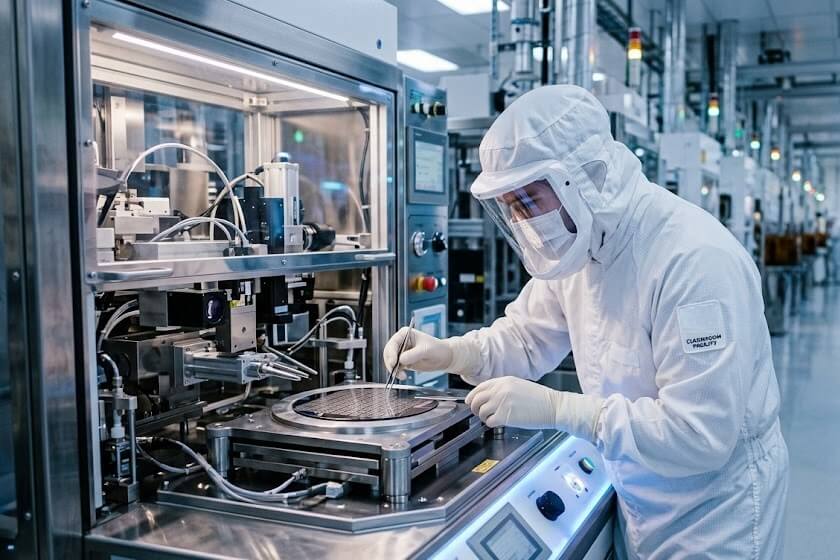
MEMS fabrication is cleanroom work. The people doing it carry specialized knowledge in semiconductor processing, materials science, precision metrology, and quality systems that meet aerospace and defense certification standards. These aren’t positions you fill from a general labour pool. They require years of training, and they pay accordingly.
Daryn Edgar, CEO of Edmonton Global, noted that the expansion reflects confidence in the Edmonton region’s technical talent, specifically, not just its infrastructure or its investment environment, but the people already here who can do this work.
That’s the part worth sitting with. Edmonton has a workforce capable of staffing a world-class MEMS foundry. Teledyne knew that in 2019, when it acquired Micralyne’s existing Edmonton operation.
Sixteen positions in precision aerospace-grade semiconductor manufacturing represent a different kind of economic contribution than sixteen positions almost anywhere else. The knowledge that stays in Edmonton when those roles are filled doesn’t leave when the project ends.
Sources
- Business Wire, June 24, 2026: https://www.businesswire.com
- Edmonton Global official statement, June 2026: https://edmontonglobal.ca
- Government of Alberta, Ministry of Jobs, Economy, Trade and Immigration media release, June 2026: https://www.alberta.ca
- Fort McMurray Today / Two Hills Chronicle regional coverage, June 2026
- MarketScreener / TipRanks investor coverage, June 2026: https://www.marketscreener.com
