What 100 Data Centers Do for Alberta Workers and Communities
Behind Alberta’s data center boom is a ground-level story most coverage is missing — the trades workers, local suppliers, and communities that will feel it long after the announcement headlines fade.
The announcements tend to arrive in the language of investment.
Billions of dollars. Megawatts of power. Hyperscale facilities. Infrastructure timelines stretching across decades. It’s the kind of news that gets picked up by the business press, circulates for a day, and gets filed away while everyone gets back to work.
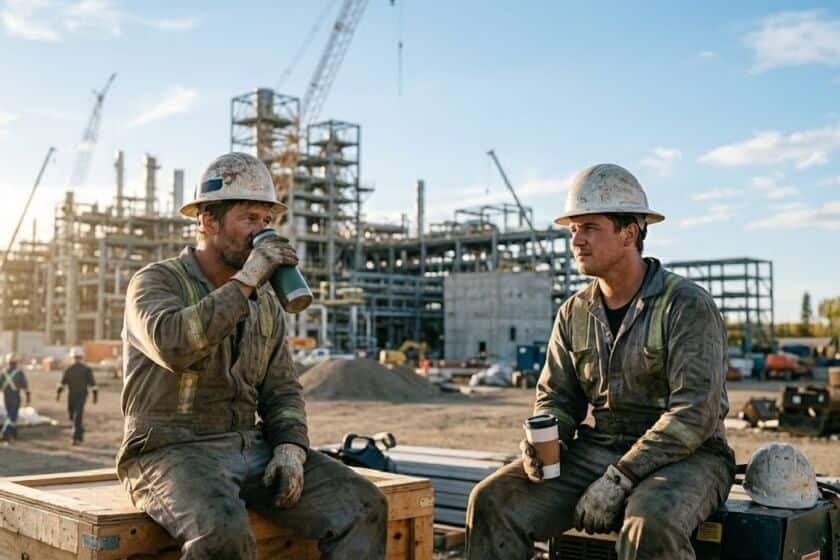
But somewhere behind every one of those announcements is a job site. A crew showing up before sunrise. A local supplier getting a call they weren’t expecting. A community that quietly becomes a different kind of place because something large and permanent decided to put down roots there.
Alberta is on the verge of hosting roughly 90% of Canada’s planned hyperscale data center buildout. What that means at street level is a different and more interesting story than the announcement headlines suggest.
What Shows Up First
A hyperscale data center takes one to three years to build. Civil work, structural steel, electrical infrastructure, mechanical systems, cooling equipment — it touches nearly every trade on the roster and runs the full project cycle rather than a seasonal one.
Electrical work sits at the centre of it. These facilities draw power at a scale that demands extensive infrastructure both inside the building and back to the grid. Mechanical contractors handle cooling systems that in Alberta’s climate can be managed more cost-effectively than almost anywhere else in North America — and that climate advantage translates directly into ongoing maintenance work long after construction wraps.
The numbers are already showing up on the ground. eStruxture’s CAL-3 facility — a $750 million, 90-megawatt hyperscale campus under construction just north of Calgary in Rocky View County — will employ around 250 people at peak construction alone, with 45 to 50 permanent technology-driven operating jobs once it opens.
Todd Coleman, founder and CEO of eStruxture, puts Alberta’s position plainly: “We see Calgary as absolutely one of the key linchpins to Canada’s foray in driving AI demand north of the border. We believe that the ultimate ecosystem of AI is going to find its way into Alberta in a rather significant way.”
CAL-3 is one project. Multiply that across dozens of facilities arriving over the next several years and the cumulative effect on Alberta’s trades workforce is substantial. Unlike much resource-sector construction, these projects tend to locate near existing communities rather than remote fly-in camps. For a tradesperson with a family, that distinction matters in ways that don’t show up in a contract value.
After the Ribbon Cutting
Construction wraps up. The facility doesn’t.
Running a hyperscale data center around the clock requires network engineers, systems administrators, security staff, and facilities managers — permanent positions with salaries that reflect the technical demands of the work. These aren’t project roles. They’re the kind of jobs that buy houses, enroll kids in schools, and become full-time careers at local businesses.
Beyond direct employment, data centers create sustained demand for local service providers — maintenance contracts, equipment inspections, logistics support, facility services that run continuously rather than project by project.
For a local contractor or service business that lands a data center as a client, the relationship tends to look different from most commercial accounts. Predictable volume. Indefinite timeline. The kind of anchor contract that lets a business owner hire with confidence and stop rebuilding the revenue forecast from scratch every quarter.
In an Alberta business environment that has historically moved with commodity cycles, that kind of stability is worth more than it might sound.
Not Your Grandfather’s Boom
Alberta has been through enough economic booms to have a complicated relationship with them.
The energy booms delivered prosperity — and then delivered the reversals that followed. The province learned, repeatedly, that an economy running on a single price signal is only as stable as that signal.
Data centers don’t run on a commodity price. The demand driving them — AI infrastructure, cloud computing, the digital backbone of virtually every industry on earth — isn’t going to have a bad quarter and pull back. The companies building these facilities are making thirty and forty-year infrastructure commitments.
Coleman put it directly: “We expect to place significant investment into Alberta over the next five to 10 years.”
That long horizon is already showing up in communities well beyond Calgary. In Fox Creek, Bitdeer broke ground on June 2nd on a vertically integrated energy and computing facility pairing a 101-megawatt natural gas power plant with approximately 100 megawatts of computing capacity — 300 construction jobs and 30 permanent positions, with priority placed on Alberta-based contractors and local hiring.
Up near Red Deer, construction is actively accelerating at the AHI Hub of Innovation at Blindman Industrial Park, where the first set of Rolls-Royce hydrogen-ready reciprocating engines has arrived on site.
For communities hosting these facilities, the distinction between a commodity project and a long-term infrastructure commitment changes the planning horizon considerably.
Getting on the Map
There’s something that happens when a community lands a major long-term industrial investment that doesn’t show up in the initial announcement — it gets noticed by the next one.
Carson Kearl, analyst at energy analytics firm Enverus, summed up what’s driving the concentration of investment in Alberta: “Calgary is developing as a tech hub in Western Canada, which also supports that growth from the data centre perspective.”
Invest Alberta CEO Rick Christiaanse put a number on the opportunity: “This is easily another $75-billion to $100-billion opportunity.”
A community with a functioning hyperscale data center has demonstrated something. That it has the infrastructure, the workforce, the grid capacity, and the operational environment to support serious industrial development. That demonstration travels. It shows up on shortlists and makes the conversation with the next investor shorter.
Alberta communities that move early aren’t just landing one project. They’re building the kind of track record that attracts what comes next.
Sources
- Varcoe: New $750M data centre to be built in Calgary area, the largest in Alberta — Calgary Herald / Chris Varcoe https://calgaryherald.com/opinion/columnists/varcoe-new-750m-data-centre-built-calgary-area-largest-alberta
- Bitdeer breaks ground on new energy and digital infrastructure facility in Alberta — Globe Newswire https://ir.bitdeer.com/news-releases/news-release-details/bitdeer-breaks-ground-new-energy-and-digital-infrastructure
- Construction accelerates at AI data centre near Red Deer — RD News Now https://rdnewsnow.com/2026/01/26/construction-accelerates-at-ai-data-centre-near-red-deer/
- Alberta pitches cheap natural gas for data center boom — BOE Report / Reuters https://boereport.com/2026/06/09/alberta-pitches-cheap-natural-gas-for-data-center-boom/
