Before the First Shovel: What $510 Million in Pipes Means for Alberta’s Trades
Alberta just landed nearly a billion dollars for infrastructure – the invisible first step that goes in before the homes get built. Here’s what it actually means for the province’s pipefitters, electricians, and trades, from the ground up.
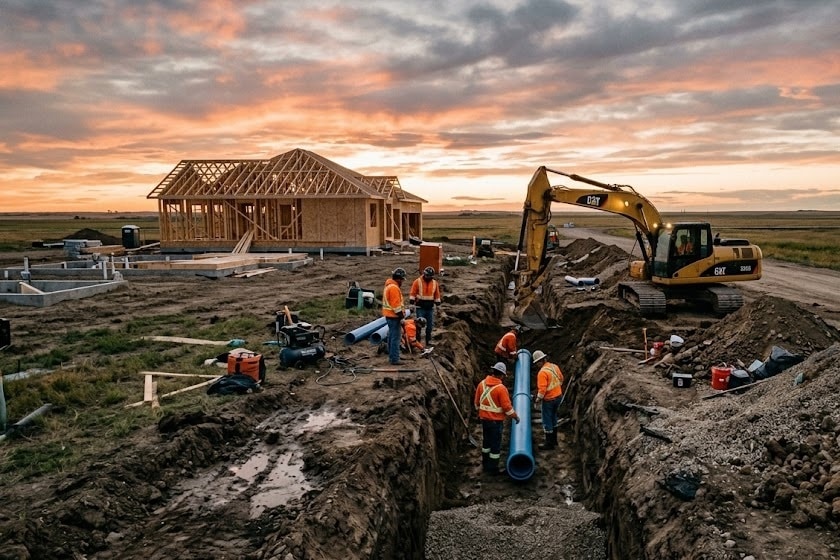
A pipefitter in Red Deer doesn’t think about housing announcements. He thinks about trench depth, frost lines, and whether the crew can get the lateral connections in before the ground freezes again.
But this week, the two things collided directly. Prime Minister Mark Carney stood in Red Deer next to Premier Danielle Smith and signed the Canada-Alberta Housing Infrastructure Fund Agreement — $510 million in federal money, with Alberta kicking in at least a third of eligible project costs, worth up to $428 million more.
Combined, that’s close to a billion dollars aimed at something most people never see: the water and wastewater lines that must be installed before a single house is built.
Smith said it plainly. “A whole lot of work has to happen in the background, and literally under the ground, before the first shovel ever breaks the surface.”
That’s not a metaphor. It’s the actual sequence of a subdivision.
The Part Nobody Photographs: Alberta’s Housing Infrastructure Gap
Housing announcements usually come with a photo of a shovel in fresh dirt, or a ribbon, or a family walking through a new front door. This one came with a canola sprayer and a lot of talk about wastewater capacity, which tells you something about where the real constraint has been sitting.
Alberta has added roughly 600,000 people over the past five years. Calgary and Edmonton have absorbed most of that, but Red Deer has felt it too — the kind of growth that shows up in school enrollment and grocery store lineups long before it shows up in a housing start number. Municipalities have had the land.
What they haven’t always had is the underground capacity to service it. A subdivision can be fully permitted, fully designed, fully ready to break ground — and stall for a year because the trunk line serving that quarter-section can’t handle another 400 homes.
This fund is aimed at that specific stall point. Eight years of municipal access to money for water and wastewater systems tied directly to new housing.
What the Fund Buys for Alberta’s Skilled Trades
Carney put a number on the labor side: 750 skilled trades jobs a year tied to this agreement alone. Engineers. Pipefitters. Electricians. Plumbers.
That’s the underground layer. But infrastructure funding like this doesn’t stay underground — it moves upward through the whole build sequence, and that’s where the “from the pipes up” math gets interesting for anyone in Alberta’s construction trades.
Once the water and sewer lines are in and inspected, the sequence that follows is fairly predictable: road base, curb and gutter, then the actual home builds start stacking up behind them. An electrician in Edmonton doing residential rough-in work is, in a very real sense, downstream of a wastewater lift station approval six months earlier. A roofer in Calgary, finishing a subdivision in October, is closing out a sequence that began with a trenching crew in the spring.
None of that shows up in the funding announcement. But it’s the actual employment chain this money sets off.
Why Alberta’s Housing Timeline Still Isn’t Fast
None of this means the housing math suddenly balances. Input costs are still elevated. Labor markets in the trades are tighter than they look on paper, especially for licensed electricians and journeyman plumbers, and that tightness doesn’t loosen just because a new fund exists.
There’s also the matter of speed. Municipal infrastructure projects — even funded ones — move through engineering review, tendering, and construction seasons that don’t compress just because the money arrived on a Wednesday in July. A contractor in Red Deer bidding on this kind of work knows the funding announcement and the first paycheck tied to it can be eighteen months apart.
And the timing isn’t accidental. This is Carney’s tenth trip to Alberta since the 2025 election, arriving less than three months before Alberta’s October 19 referendum on Confederation. Separatist supporters gathered at a distance while he spoke. The politics around this money are real, even if the pipes underneath it are apolitical.
What It Means for Alberta Construction and Trades Work
Strip away the ribbon-cutting and the politics, and what’s left is a fairly straightforward equation: Alberta’s population isn’t slowing down enough to matter, its municipalities have been infrastructure-constrained rather than land-constrained, and there’s now close to a billion dollars aimed at the specific bottleneck that’s been holding subdivisions back.
For a construction company in Calgary, an electrical contractor in Edmonton, or a plumbing crew based out of Red Deer, that’s not a headline. It’s a pipeline of actual work, moving from the ground up over the next several building seasons — provided the engineering and tendering keep pace with the money.
The pipes go in first. Everything else in Alberta’s housing story gets built on top of them.
Sources:
- https://www.theglobeandmail.com/canada/alberta/article-carney-smith-housing-plan-alberta-homebuilding/
- https://www.cbc.ca/news/canada/edmonton/carney-announces-canada-alberta-housing-fund-9.7289244
- https://www.ctvnews.ca/calgary/video/2026/07/29/alberta-to-get-500m-for-housing-infrastructure-ctv-news-calgary-noon-update-for-july-29-2026/
- https://calgaryjournal.ca/2026/07/29/carney-comes-to-alberta-talks-housing-rides-a-sprayer-hears-from-separatists/
- https://www.narcity.com/carney-smith-announce-housing-plan-in-alberta
