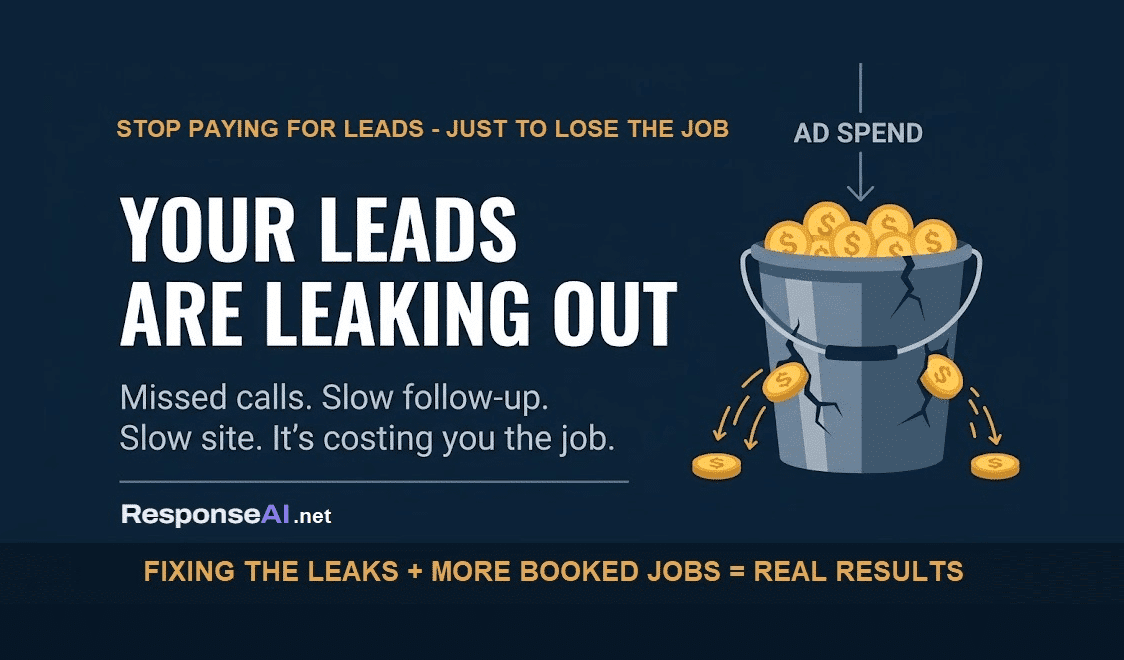
Are You Paying For Leads – Just To Lose The Job
Every service business eventually reaches for the same lever: spend more on ads. More traffic, more calls, more form fills. It feels like the obvious move — until the results don’t scale with the budget.
Why lead capture trumps ad spend.
The reason is rarely the ad. It’s what happens in the seconds and minutes after someone responds to it. A campaign can do its job perfectly — get the right person to call or click — and still lose the job, because the funnel behind it leaks in two separate places: before the inquiry, and right after it.
Leak #1: The visit never becomes an inquiry
This is the classic conversion-rate problem, and it’s well documented. A page that loads slowly, buries the phone number, or looks broken on a phone will quietly turn paid traffic into wasted spend before a lead is ever generated:
- Speed. Roughly half of mobile visitors abandon a page that takes longer than 3 seconds to load, and the bounce rate climbs sharply the longer it takes.
- Clarity, not click-counting. Visitors don’t leave because a phone number took “too many clicks” to find — they leave when they can’t quickly tell they’re in the right place. Simple layouts with an obvious next step outperform clever ones.
- Specific calls-to-action. “Submit” undersells the offer. “Get My Free Estimate” or “Book My Appointment” consistently outperforms generic button copy in large-scale analyses.
- Short forms. Every additional field costs conversions. Long checkout or quote-request forms are a documented reason people abandon mid-request.
- Proof. The majority of consumers read reviews before calling a service business, and a meaningful share won’t engage at all with a company that has none.
- Mobile-first design. Mobile now accounts for the majority of web traffic. A site that isn’t built mobile-first is turning away the majority of its own audience.
This is standard website and ad-optimization territory — get the site fast, clear, and proof-backed, and paid traffic actually converts into inquiries at the rate it should.
Leak #2: The inquiry never becomes a booked job
This is the leak most service businesses don’t see, because it doesn’t show up as a bounce rate — it shows up as a phone that never rings back, or a lead who quietly booked with whoever answered first.
The research here is stark. Businesses that respond to a new lead within five minutes are dramatically more likely to actually make contact and qualify that lead than those who wait even thirty minutes — some studies put the gap at more than 20x.
Speed compounds: contacting a lead within the first minute converts far better than contacting them two minutes later. And the majority of buyers simply go with whichever business responds first — not the cheapest, not even the best reviewed. The fastest.
Meanwhile, most businesses are nowhere close. Average first-response times across industries are commonly measured in hours, not minutes — and for home service businesses specifically, a large share of after-hours and weekend calls go unanswered entirely.
Every one of those is a lead that was already paid for and then handed to a competitor for free.
The same leak shows up in three other quiet ways:
- Missed calls. Business owners consistently believe they answer nearly every call; independent data suggests they’re actually missing more than 1 in 3.
- No-shows. A booked appointment with no reminder system is a coin flip. A missed appointment is a wasted slot that could have gone to someone else.
- The reputation gap. A finished job that never gets a review request is a missed opportunity to build the exact proof that Leak #1 depends on.
Why order matters
Scaling ad spend before sealing the leak means paying more to lose more. The sequence that actually compounds:
- Fix the site. Speed, clarity, mobile experience, and proof — so paid traffic converts into inquiries at a healthy rate.
- Fix the response. Every call, text, and web chat answered in seconds, not hours — so inquiries convert into booked jobs instead of going to whoever called back first.
- Close the loop. Reminders that prevent no-shows, and review requests that turn finished jobs into the next inquiry’s reason to trust you.
- Then scale spend. Once both ends of the funnel are solid, every ad dollar lands on a system built to convert — not leak out before it has a chance to.
The takeaway
“Buy more leads” is usually the wrong first move. The businesses winning right now aren’t necessarily spending more on ads — they’re the ones who show up first, on a fast site that offers online booking, fast follow-ups so nothing falls through the cracks.
Fix the capture and response layer, and the traffic you’re already paying for starts converting as it should. Only then does turning up ad spend actually pay off.
If you’re tired of paying for ads just to lose the jobs and are ready to fix the leaks.
Get in touch with ResponseAI.net
