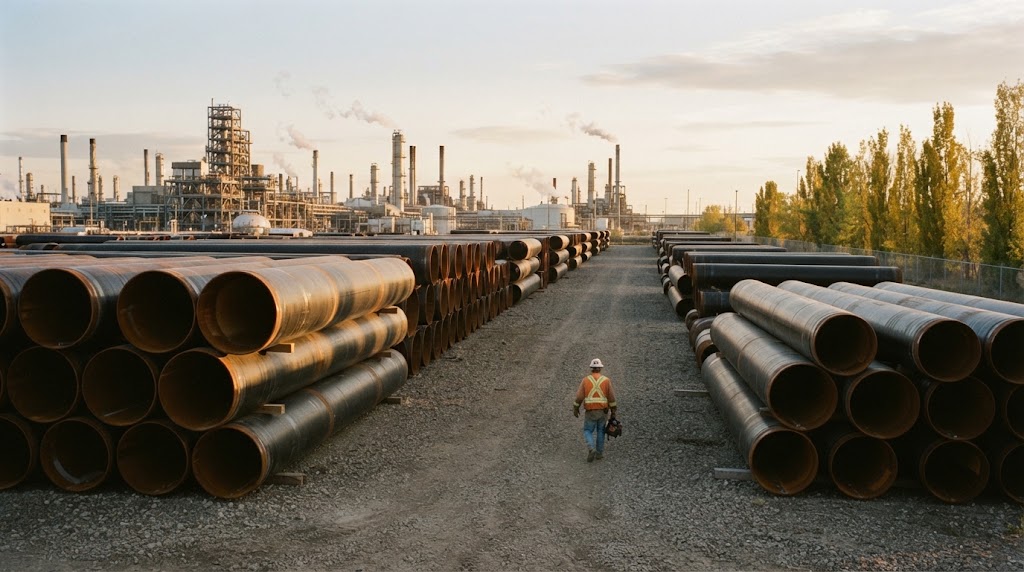
Alberta Is Pumping More Oil Than Ever. The Pipe Is Almost Full.
Alberta is now producing a record 4.4 million barrels a day, but the Trans Mountain pipeline is running at 94% capacity. Here’s what Ottawa’s October 1st pipeline decision means for jobs, growth and communities across the province.
That 4.4 million barrels of oil a day is a record, and it comes after back-to-back years where output grew by roughly 4%. With crude prices climbing too, the effect has spread well past the oil patch into corporate profits and household incomes. It has also reached the provincial books, where a projected $9.4 billion deficit turned into a forecast $2 billion surplus by the first-quarter update. Royalties did most of that work.
TD Economics put out its fall provincial forecast on Monday. It has Alberta growing 2.3% this year, second only to Newfoundland and Labrador, then moving into first place in 2027. The whole country, for comparison, is expected to manage 0.9%.
None of that is really in dispute. What’s less settled is where the next barrel goes.
Trans Mountain Is Running at 94% Capacity
Trans Mountain is a big part of how we got here. Before the expansion started running in 2024, Alberta’s energy exports went almost entirely to the United States, and Asia took something like 1%. It’s close to 8% now. China was importing more than 200,000 barrels a day of Canadian crude by late 2025, partly because its refineries are among the few in the world set up to run heavy oil in volume.
Anyone who remembers the years when Western Canadian Select sold at a painful discount will understand why that matters. Back then there was essentially one buyer.
The trouble is that TMX is running at around 94% of its 890,000 barrel-a-day capacity, and TD says that’s limiting how much more production can grow in the near term. Optimization work on the line should get it to about 1.19 million barrels a day by the end of 2028. ATB has been warning since winter that without new pipe, capacity could start holding output back again as soon as 2028.
What that looks like on the ground isn’t dramatic, at least not at first. Producers don’t announce they’re stopping. A drilling program that would have gone ahead gets moved to “under review” in a Calgary office. A year or so later the rig crews out of Drayton Valley notice fewer calls, and then the fab shops in Nisku do.
The October 1st Decision on a West Coast Pipeline
On October 1st Ottawa decides whether the proposed west coast oil pipeline gets national-interest status. The proposals on the table have it moving more than a million barrels a day at a cost of roughly $40 billion. It has been packaged with the Pathways carbon capture project and a set of federal-provincial agreements on carbon pricing and project approvals.
Even a yes wouldn’t mean much digging anytime soon. TD’s analysis in July laid out a best case: construction starting in late 2027, a final investment decision in 2028 or 2029, and oil flowing sometime between 2032 and 2034. That assumes B.C. gets on board, the legal challenges get sorted out and Indigenous consultation is done properly.
So for a pipefitter in Fort Saskatchewan, October 1st is mostly about the 2030s. It could mean steady work within driving distance of home, or another decade of rotations out of camp. Plenty of people in the trades around Edmonton have lived the second version and would rather not do it again.
One detail in the TD report is easy to miss. The pipeline isn’t in the bank’s forecast at all. Every number above assumes Alberta doesn’t get it.
Alberta Jobs and Housing Beyond the Oil Patch
It’s easy to talk about oil and forget everything else. Jobs in Alberta are up 3.5% so far this year versus 0.5% nationally, and people here are spending more than in most provinces. Non-residential construction is climbing as well, which helps cover for housing starts coming down off last year’s record.
Housing is the odd one out. A realtor in Red Deer right now might have more clients with steady jobs and recent raises than she’s had in years, and fewer of them actually buying. TD has Alberta home sales falling 9.3% in 2026. Higher borrowing rates and slower population growth are doing most of the damage. The bank expects resales and prices to grind out modest gains over the next few years as some of that pent-up demand comes back. Nobody in real estate would choose that pace, but it’s movement in the right direction.
How Tariffs Are Splitting Canada’s Economy
The broader report splits the country pretty cleanly. Alberta, Saskatchewan and Newfoundland and Labrador are getting higher incomes, profits and government revenue out of $100 oil. Commodity exemptions and more diversified export markets mean the trade fights hit them less. Ontario, Quebec, Nova Scotia and New Brunswick are taking tariffs and higher energy costs at the same time, without much coming back the other way.
An auto parts worker in Windsor is looking at a possible 25-point jump in the U.S. tariff on autos and parts in January. A welding shop in Nisku, meanwhile, might be booking work into next summer. Alberta isn’t untouched, and TD says trade uncertainty and retaliatory tariffs will still weigh on some manufacturing here. But with energy as big as it is, the province sits further from the trouble than most.
Out at the Westridge terminal in Burnaby this week, there’s likely a tanker loading Alberta crude for a refinery in Asia that wasn’t buying from us five years ago. It came through a pipe that doesn’t have much room left in it.
Sources
TD Economics, “Provincial Economic Forecast: Trade Frictions Widen Regional Growth Gaps,” September 21, 2026
https://economics.td.com/provincial-economic-forecast
TD Economics, “Pipelines and Pathways: Canada’s Energy Bargain Takes Shape,” July 2026
https://economics.td.com/ca-pipeline-and-pathways
ATB Financial, The Twenty-Four, “1.5 billion barrels,” February 2026
https://www.atb.com/company/insights/the-twenty-four/alberta-oil-production-in-2025/
