The $51 Billion Reason Ottawa Came to Red Deer
Federal minister Dominic LeBlanc visited Fort McMurray and Red Deer this week — bringing $51 billion in infrastructure funding and a push to tear down Canada’s interprovincial trade barriers.
Canada’s internal trade minister made two Alberta stops this week to make the same case in two settings. Fort McMurray got the energy conversation. Red Deer got the infrastructure money and the pitch to become Canada’s domestic trade corridor.
Monday, Dominic LeBlanc was in Fort McMurray.
He toured Suncor’s Base Plant — the original commercial oil sands operation, still producing, now running two new cogeneration units that have cut the facility’s emissions while sending power back to the provincial grid. He met with senior Suncor executives. The conversation covered pipelines, the Canada-Alberta Memorandum of Understanding, and the Pathways carbon capture project.
At the Fort McMurray Chamber of Commerce, he sat down with Chamber President Dianna De Sousa and made the case that Alberta’s energy sector and Ottawa’s current priorities are more aligned than they’ve been in years.
Then on Tuesday, he was in Red Deer.
A Different Room
The Chamber crowd in Red Deer is a different mix than Fort McMurray’s — manufacturers, distributors, agricultural suppliers, contractors, and professional services firms. Mayor Cindy Jefferies was there. So were trade and industry leaders who spend their working lives moving goods and equipment across provincial lines and absorbing the costs that come with it.
LeBlanc’s message in Red Deer wasn’t about bitumen. It was about infrastructure funding and the federal push to knock down the regulatory walls between provincial economies. He talked about the $51 billion Build Communities Strong Fund, which launched in April and runs over ten years, with $3 billion per year flowing on an ongoing basis beyond that. He talked about the new Domestic Trade Commissioners Network. He talked about CUSMA.
What tied it to Fort McMurray is that both stops were really the same conversation: Ottawa is trying to make the case — in the oil patch, in the logistics corridor, and everywhere in between — that rebuilding Canada’s economy runs through Alberta.
Red Deer, sitting 150 kilometres from both Calgary and Edmonton on the QEII, is where that argument either connects to something real or it doesn’t.
The Money and What It Takes to Get It
Alberta’s allocation under the Build Communities Strong Fund’s provincial-territorial stream is $1.9 billion. That’s a concrete number attached to a program that is now open, not a pledge for a future government to figure out.
But it doesn’t arrive automatically. Funding moves through separate streams — provincial-territorial, direct delivery, and community — each with its own application process, eligible categories, matching requirements, and federal approval timelines.
A municipality like Red Deer that wants to make a case for a road upgrade on a key industrial corridor, or a short-line rail improvement that affects freight movement, has to build that case, find the matching funds, and work through either PrairiesCan or the provincial-territorial stream, depending on what it’s building and who’s delivering it.
LeBlanc’s framing in Red Deer was that this shouldn’t be thought of as a general community infrastructure program. The pitch was that infrastructure and internal trade reform are the same file. A road that gets equipment to a job site in another province faster, an airport expansion that opens cargo capacity, serviced industrial land that lets a manufacturer scale — those aren’t separate from reducing trade friction.
They’re how trade friction actually gets reduced on the ground, rather than in a policy document.
Red Deer Regional Airport is mid-expansion, with 200 acres of aviation and commercial land expected to open up. The city’s short-line railway connects to CPKC trackage.
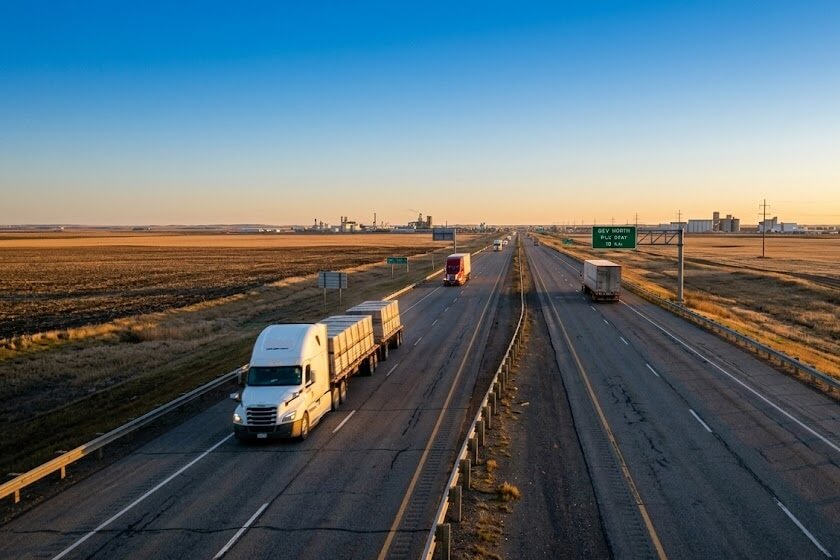
The QEII corridor moves more than 16 million vehicles annually. The city’s own economic development office describes a trade area reaching 15 million people across Western Canada and into the U.S. Pacific Northwest.
More than 4,000 businesses operate here across construction, manufacturing, energy services, retail, and professional trades.
That’s why a minister whose file is internal trade picked Red Deer as his second stop.
The Hidden Cost of Selling Across Provinces
A Statistics Canada study from 2017 estimated that the effect of provincial borders on goods trade was roughly equivalent to a 6.9% tariff. That number is a decade old, and economists dispute how well it fits our current economy.
But the underlying problem it describes hasn’t gone away.
A metal fabricator in Red Deer shipping custom equipment to a construction project in Manitoba runs into trucking regulations that differ by province — weight limits, rest area requirements, and oversize load rules that aren’t harmonized. A food processor moving product out of Alberta encounters inspection regimes that don’t line up at the border.
None of this involves a customs agent. It’s just friction. And friction, over enough volume, adds up to something that looks a lot like a cost on trade.
Ottawa has started moving on it. Federal regulations under the Free Trade and Labour Mobility in Canada Act came into force in January, recognizing comparable provincial standards for goods, services, and worker credentials in areas of federal jurisdiction.
The Domestic Trade Commissioners Network LeBlanc announced in Red Deer is meant to give businesses a practical resource for navigating interprovincial markets — not just a signal that the markets are open, but actual support for using them.
Whether that’s enough to move the needle for a small manufacturer trying to win a contract in Saskatchewan is a separate question.
The Other Thing Businesses Are Watching
CUSMA came up at both Alberta stops. LeBlanc flagged energy, manufacturing, and agriculture as the sectors most exposed in the summer review.
For Red Deer businesses with U.S. customers or U.S.-linked supply chains, the review is running alongside everything else — the internal trade push, the infrastructure funding applications, the post-pandemic recalibration of what markets are actually reliable.
The federal argument is that a stronger domestic market reduces exposure to the results that come out of that review. Canada becoming its own best customer, as LeBlanc put it, means a manufacturer in Red Deer has somewhere to sell besides across the 49th parallel.
Whether the policy catches up to the reality of what it costs to sell across provincial lines is what the next few years will show.
Sources
READOUT — Minister LeBlanc meets with municipal and business leaders in Red Deer, Government of Canada via Newswire, June 24, 2026:
https://www.newswire.ca/news-releases/readout-minister-leblanc-meets-with-municipal-and-business-leaders-in-red-deer-858277052.html
READOUT — Minister LeBlanc meets with business leaders in Fort McMurray, Government of Canada via Newswire, June 23, 2026:
https://www.newswire.ca/news-releases/readout-minister-leblanc-meets-with-business-leaders-in-fort-mcmurray-801439048.html
Build Communities Strong Fund, Housing, Infrastructure and Communities Canada:
https://housing-infrastructure.canada.ca/bcsf-fbcf/index-eng.html
Government of Canada — One Canadian Economy:
https://www.canada.ca/en/one-canadian-economy.html
Statistics Canada — Going the Distance: Estimating the Effect of Provincial Borders on Trade:
https://www150.statcan.gc.ca/n1/pub/11f0019m/11f0019m2017394-eng.htm
City of Red Deer — Why Red Deer?:
https://secure.reddeer.ca/business/business-environment/why-red-deer/
