Wheatland County Now Makes Walls for Alberta Homes
A century-old hamlet south of Calgary lost its grain elevators, its bank and its car dealership over the past fifty years. A new $210-million plant just gave Wheatland County its biggest hiring event in a generation.
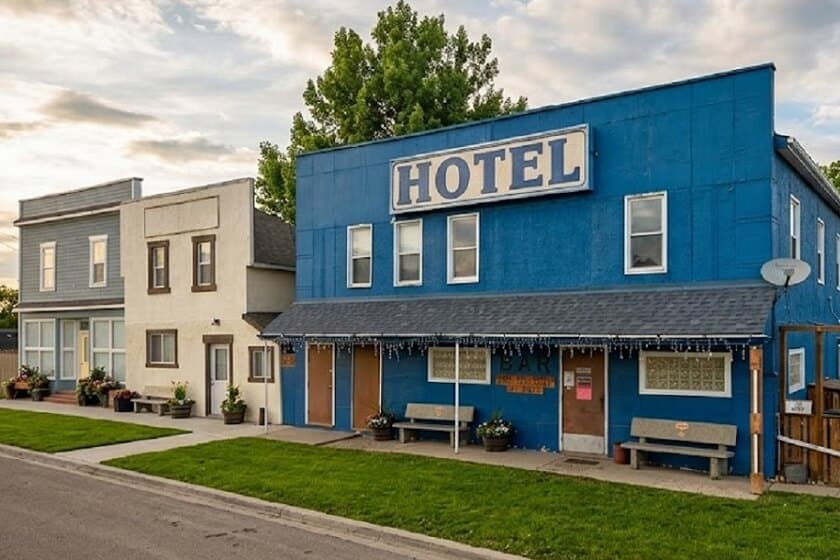
On Railway Avenue in Carseland, three buildings from 1916 are still standing — an old hotel, a former meat market doing duty double duty as the post office, and what used to be the hardware store. That’s what’s left of a town that once ran six grain elevators on the CP line, a Ford dealership, a bank, two churches, a stockyard and a hotel busy enough to need one.
Carseland boomed through the 1920s and 1930s on irrigation water and rail traffic, then spent the next half-century doing what most prairie hamlets along Alberta’s branch lines did — losing businesses and reasons to stay in increments small enough that nobody could point to the day it happened.
It’s a pattern many rural Albertans know even without the history. Grain handling consolidated into a handful of inland terminals decades ago. High schoolers leave for the city for work or school, and the ones who come back are the exception, not the rule.
The population numbers can look fine on paper — Carseland counted 542 people in the last census, barely up from 525 five years earlier — but a flat population count doesn’t mean a town is thriving. It can just mean people haven’t left yet.
What disappears first is the reason to stay: the local employer, the apprenticeship, the job that doesn’t require an hour each way on Highway 24.
That’s the part of the math that just changed.
What Showed Up In Wheatland County
On June 10th, CGC Inc. — Canada’s largest gypsum wallboard manufacturer — officially opened a $210 million plant in the Goldfinch industrial area, a few minutes down Highway 24 from Carseland’s three remaining buildings on Railway Avenue.
The 220,000-square-foot facility sits on 214 acres and produces Sheetrock-brand wallboard, the drywall that goes up behind the paint in nearly every new home, office and school across Western Canada. CGC says the plant employs close to 100 people directly, with another 80 jobs tied to operations and the activity that builds up around a facility this size.
In a county of fewer than 9,000 residents, that’s the kind of hiring event a place this size doesn’t see often.
Ask what 180 jobs actually means out here and the answer isn’t abstract. It’s the millwright in Strathmore who’s been driving forty minutes into Calgary for shift work and can now apply five minutes from his driveway.
It’s a family in Carseland who’d assumed their kid’s graduating year would also be the year they moved away, recalculating. It’s the diesel mechanic picking up new business from a plant’s worth of new trucks and equipment.
None of that shows up in a press release. All of it shows up in a town.
Not the Only New Arrival
Wheatland County isn’t new to industry. Nutrien, Orica and Stella-Jones have had operations running along the Goldfinch corridor for years, handling everything from fertilizer to treated rail ties at a scale most people driving Highway 24 never notice. What’s changed is the pace.
De Havilland Canada broke ground in May 2026 for a final assembly hub for three aircraft: the Dash 8-400, the DHC-6 Twin Otter and the DHC-515 Firefighter. De Havilland projects up to 1,500 direct jobs for its fully operational plant, with Alberta’s government projecting the broader economic impact could reach 3,000 jobs.
Add CGC’s plant to that list, and an hour-from-Calgary county that still runs an Ag Days parade and a curling rink every winter is becoming one of the more active industrial corridors in southern Alberta — without losing the identity that made people want to stay there in the first place.
The plant also sits near the western edge of Siksika Nation territory, and the partnership showed up at the podium as much as the ribbon-cutting did. Siksika Chief Samuel Crowfoot spoke about “the value of partnership” and the long-term opportunities the investment could create.
Wheatland County Reeve Scott Klassen called it confirmation that the region still draws “confidence” from outside investors — it’s a topic Reeve may like to raise at every event, and this time the numbers behind it are genuinely unusual for a county this size.
CGC president Steve Youngblut framed the plant as a “long-term commitment to Western Canada” — language companies use often enough that it can sound automatic, except CGC backed it with a $210 million build and a foundation that didn’t exist three years ago.
While the Goldfinch industrial area may not have its grain elevators anymore, it now has a solar field, with panels catching the early light across a site that was bare prairie not long ago.
Not exactly the skyline anyone in Carseland grew up imagining. It’s the one that showed up anyway.
Sources:
https://www.usg.com/en-CA/about-cgc/news-articles/cgc-opens-new-wheatland-manufacturing-plant
https://calgaryherald.com/business/local-business/cgc-officially-opens-210-million-wallboard-plant-wheatland-county
https://www.connectcre.ca/stories/cgi-opens-new-210m-wallboard-plant-in-wheatland-county/
https://wheatlandcounty.ca/community-profile/
https://en.wikipedia.org/wiki/Carseland
https://en.wikipedia.org/wiki/Wheatland_County,_Alberta
