
Five Charts Explain Alberta’s Economy
A new Business Council of Alberta analysis highlights five major trends shaping Alberta’s economy, from GDP growth and investment to labour pressures, diversification, and the changing role of local businesses.
Alberta’s economy is growing again — but the story underneath the numbers is becoming more layered than many people realize.
Economic conversations in Alberta often swing between extremes.
Boom or bust. Optimism or concern. Oil prices up or down.
But the reality shaping Alberta businesses in 2026 is more nuanced than that. A recent Business Council of Alberta analysis used five charts to explain where the province currently stands economically, and together they tell a story that feels both familiar and quietly different at the same time.
There are signs of strength. But there are also signals that growth is becoming more uneven, more interconnected, and more dependent on how Alberta manages the pressures that come with expansion.
For local businesses across the province, those pressures are already becoming part of everyday operations.
1. Alberta’s Budget Picture Has Improved — But Volatility Still Shapes the Province
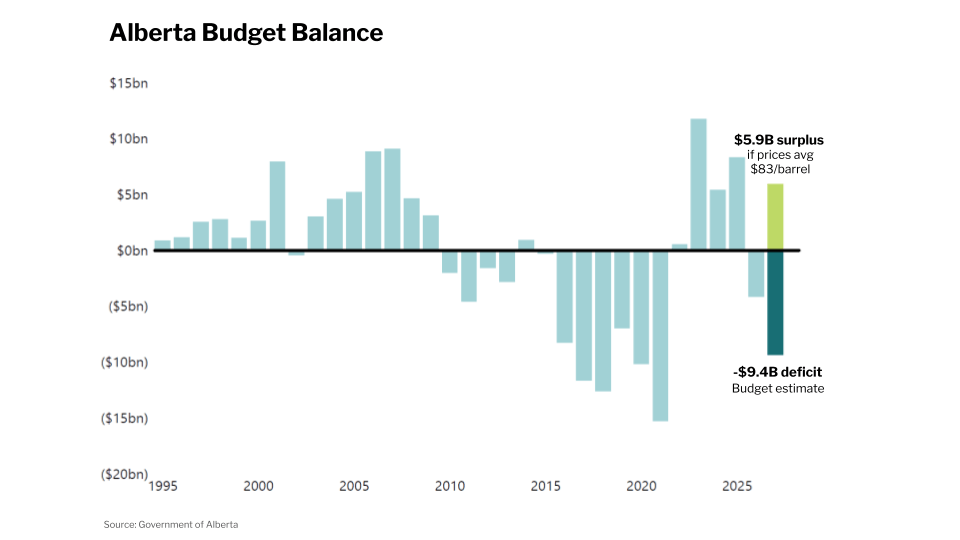
One of the clearest charts in the Business Council analysis shows Alberta’s budget position improving significantly compared to previous deficit years.
For many Albertans, that creates a sense of cautious stability after years of economic uncertainty. Government revenues tied to stronger resource activity and higher energy prices have helped strengthen the province’s financial position heading into 2026.
But the chart also reflects something Alberta businesses understand well: the province’s finances still remain closely connected to cyclical industries.
That reality affects more than government accounting.
When Alberta’s fiscal position strengthens, infrastructure projects, investment confidence, hiring activity, and consumer spending often improve alongside it. Contractors become busier. Local suppliers see stronger demand. Restaurants and service providers feel greater economic activity moving through communities.
At the same time, many business owners remain aware that Alberta’s economy can still shift quickly when broader commodity conditions change.
That cautious optimism continues shaping decision-making across the province.
2. Construction Investment Continues Reshaping Alberta Communities
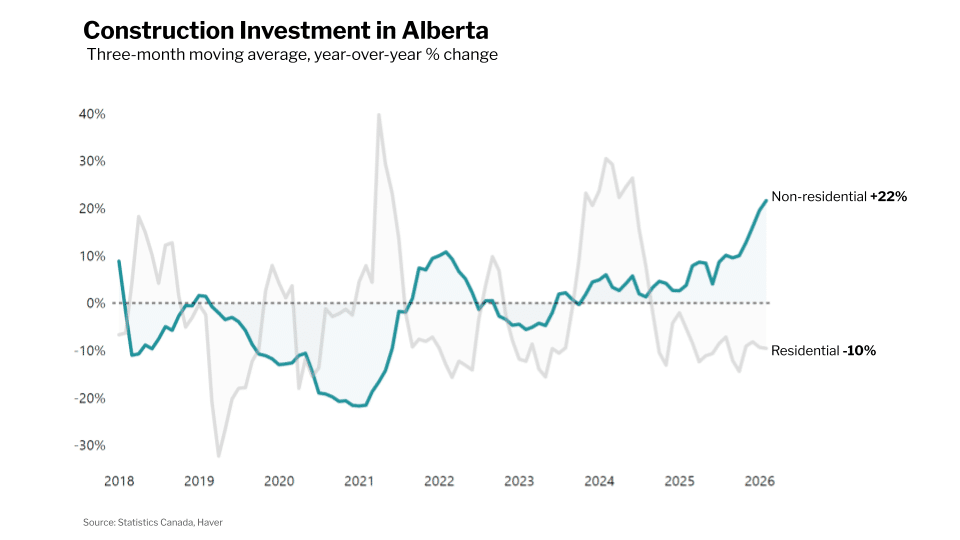
Another chart highlights the enormous scale of construction investment continuing across Alberta.
The visible effects are difficult to miss.
New subdivisions expand around Calgary and Edmonton. Industrial projects continue developing across northern Alberta. Infrastructure upgrades, commercial construction, and housing demand are reshaping communities throughout the province.
For businesses, construction investment creates ripple effects far beyond the building sector itself.
Trades companies, engineering firms, equipment suppliers, transportation providers, cafés, hotels, accountants, cleaners, landscapers, and automotive services all benefit when construction activity remains strong.
In communities like Red Deer, Grande Prairie, and Medicine Hat, construction momentum often influences the broader local economy long before formal economic reports fully capture the impact.
But sustained growth also creates pressure.
Labour shortages, rising costs, permitting delays, and infrastructure strain are becoming increasingly common operational realities for Alberta businesses trying to keep pace with expansion.
3. Alberta’s Unemployment Rate Still Tells a Complicated Story
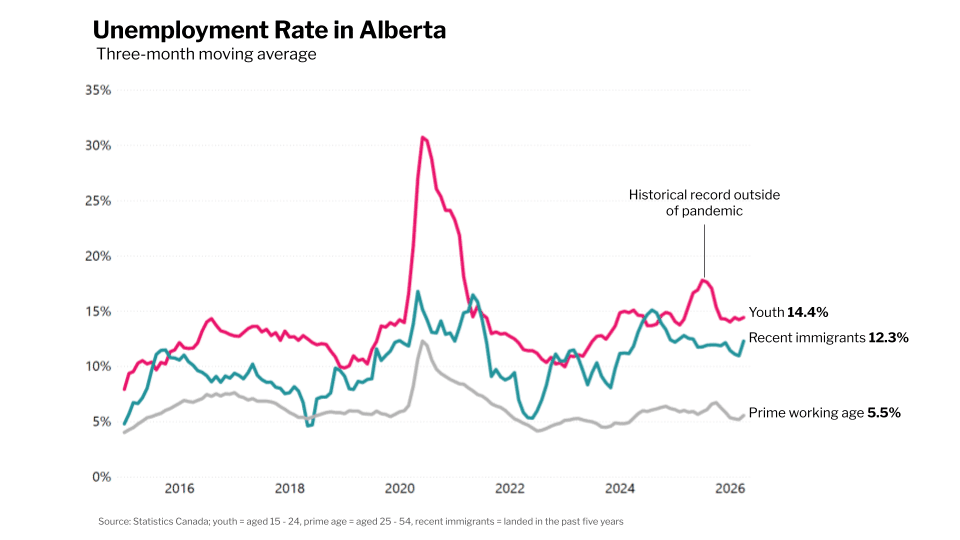
Alberta’s unemployment rate has improved significantly from some of the province’s more difficult economic periods.
Yet the labour market remains more complicated than the headline numbers alone suggest.
Many businesses continue struggling to find skilled workers despite broader economic growth. Contractors compete aggressively for tradespeople. Healthcare providers face staffing shortages. Restaurants and hospitality operators still deal with inconsistent labour availability. Technical and professional sectors increasingly recruit nationally to fill specialized roles.
This creates an unusual dynamic within Alberta’s economy.
In some industries, businesses are searching desperately for workers while other sectors continue adjusting to changing economic conditions at the same time.
For many Alberta employers, labour challenges are no longer temporary disruptions. They are becoming a permanent part of operating a business in a fast-growing province.
4. Alberta Is Still Forecast to Lead Provincial Growth
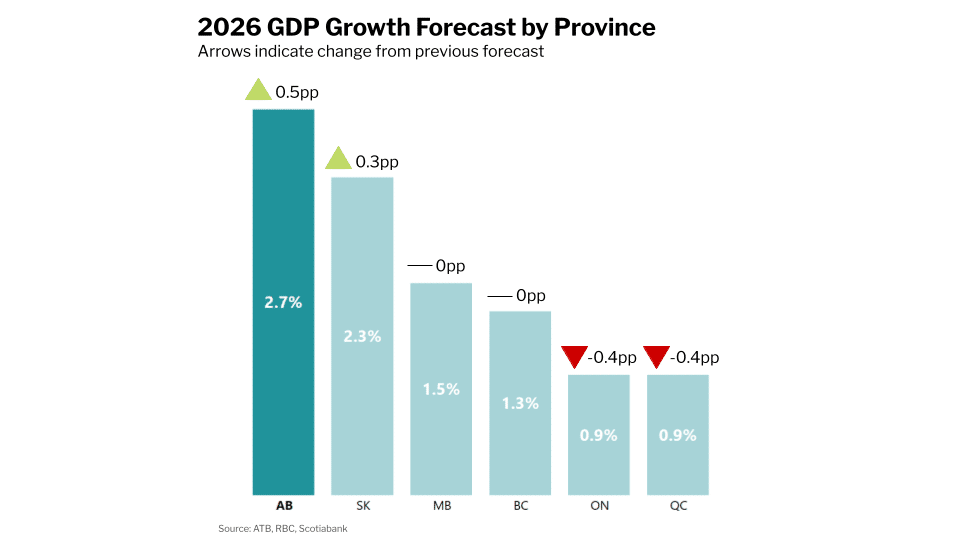
One of the most optimistic charts in the Business Council analysis compares projected GDP growth across Canadian provinces — with Alberta remaining near the top of the list.
That forecast helps explain why Alberta continues attracting people, investment, and business activity from across the country.
Compared to many provinces, Alberta still offers relatively lower taxes, younger demographics, strong wages in key industries, and opportunities tied to both traditional and emerging sectors.
But growth leadership brings new expectations.
As Alberta expands, pressure grows on housing, healthcare systems, infrastructure, transportation, and local services. Businesses that once operated comfortably at smaller scale are increasingly adapting to a province becoming larger, busier, and more economically interconnected all at once.
This may become one of Alberta’s defining challenges heading into 2027:
not simply generating growth, but managing it sustainably.
5. Oil Prices Still Matter — Even in a More Diversified Alberta
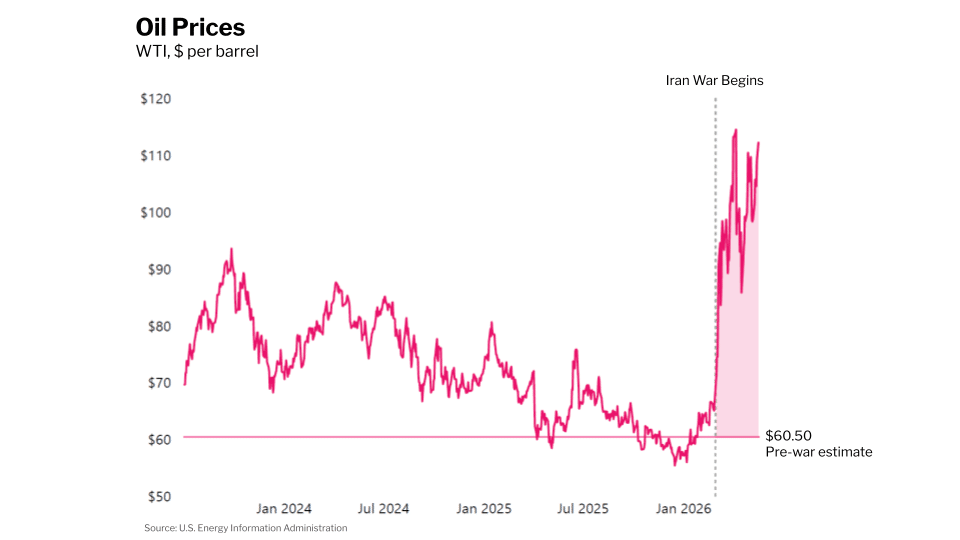
The final chart serves as a reminder that despite Alberta’s evolving economy, oil prices still carry enormous influence throughout the province.
Energy revenues continue shaping government finances, investment confidence, employment activity, and industrial development across Alberta.
Even businesses operating far outside the energy sector often feel the ripple effects.
A rise in oil prices can increase industrial activity, strengthen local spending, improve hiring confidence, and generate broader momentum throughout Alberta communities. A decline can slow projects, reduce investment, and create caution across industries that depend indirectly on economic confidence.
At the same time, Alberta’s economy today is more layered than it was a generation ago.
Technology, logistics, manufacturing, professional services, healthcare, construction, agriculture, and local service businesses all play larger roles in the province’s economic stability than many older narratives fully acknowledge.
That diversification may help Alberta weather future volatility more effectively — even if energy remains foundational to the province’s identity and economic strength.
Alberta’s Economy Is No Longer Defined by One Story
The five charts highlighted by the Business Council of Alberta ultimately point toward a broader reality: Alberta’s economy is evolving beyond simple narratives.
Energy still matters deeply.
But so do migration, infrastructure, skilled labour, local services, technology, logistics, manufacturing, and the thousands of businesses quietly adapting alongside a changing province.
The businesses likely to thrive over the next several years may not simply be the largest or fastest-growing. They may be the businesses most capable of adapting to a province that is becoming more connected, more demanding, and more economically layered all at once.
Because behind Alberta’s economic charts are still everyday businesses quietly keeping communities functioning.
A contractor managing growing demand. A clinic adding staff. A logistics company expanding routes. A café serving a rapidly changing neighbourhood. A family-run business adapting alongside the province around it.
Those quieter stories rarely appear in economic graphs.
But they are often where Alberta’s future becomes visible first.
And in a province built on people who show up without applause, local discovery still matters. Alberta’s Best exists to help Albertans continue finding the businesses, services, and communities that quietly keep the province moving forward.
Sources
- Business Council of Alberta — Five Charts That Explain Alberta’s Economy
https://businesscouncilab.com/insights-category/econminute/five-charts-that-explain-albertas-economy/
