Calgary Is Becoming the Kitchen for Canada’s Meal Revolution
Factor Meals just opened a 50,000-square-foot commercial kitchen in Calgary — and it’s not the only meal brand making that move.
Something has been happening in Calgary’s food economy that doesn’t always get announced with much fanfare.
A Berlin-founded company — one of the largest meal kit operations on the planet — looked across North America for a western production base and chose Calgary. Not Vancouver. Not Edmonton. Not a US border city with easier logistics south.
Calgary.
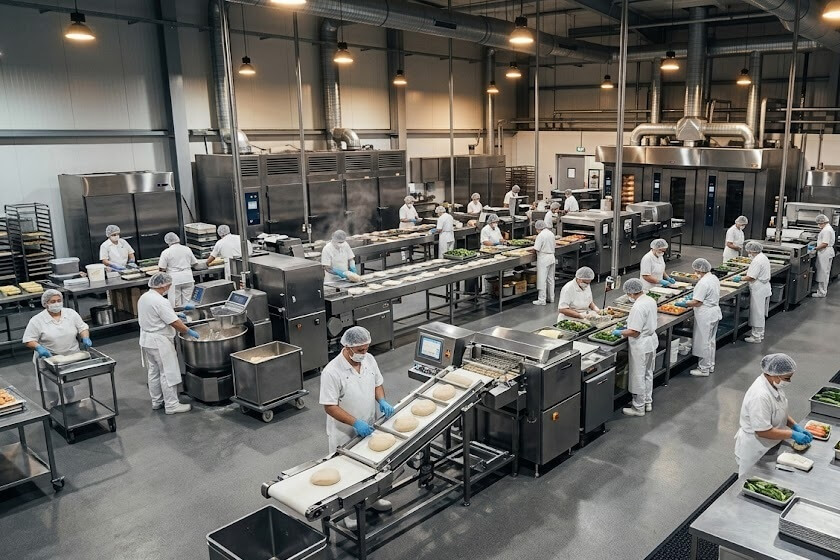
Factor Meals, the ready-to-eat subsidiary of HelloFresh, opened a 50,000-square-foot commercial kitchen and distribution centre in the city this spring. The facility is already operational. Four hundred jobs across production, logistics, and management. Nationwide delivery to Western Canada is rolling out this fall.
The $19.5 million investment came with $3.6 million in provincial and federal support — a combination of Alberta’s Agri-Processing Investment Tax Credit and a Sustainable Canadian Agricultural Partnership grant.
But incentives don’t fully explain a decision of this size. Companies don’t build at this scale because of a tax credit. They build where the fundamentals make sense.
Why Factor Meals Chose Calgary
Factor Meals launched in Canada in 2022, serving Ontario, Quebec, and the Maritimes. For four years, Western Canada was effectively off the menu — not because of a lack of demand, but because the economics of shipping fresh, temperature-controlled meals across the country from a single eastern kitchen didn’t work.
The Calgary facility changes that math. Centrally located for western distribution, close to a deep agricultural supply chain, and operating in a province that has spent years making the case that it’s easier to build here than almost anywhere else in Canada.
Kevin Marban, Factor Meals’ general manager, said it directly: Alberta’s can-do attitude, its food processing sector, its skilled workforce, and its business environment made Calgary the natural choice. Calgary’s central position in Western Canada shortens delivery routes, improves freshness, and builds a more resilient supply chain.
That’s not the language of a company that needed convincing. That’s the language of a company that ran the numbers and reached a conclusion.
Calgary’s Agri-Processing Is Attracting Investment
The Factor announcement lands at an interesting moment. The same week, Montreal-founded WeCook — a ready-to-eat meal company that has grown more than 1,000 percent since 2020 — announced it was expanding into six Western Canadian cities, Calgary among them.
Two significant meal brands, arriving in the same market, in the same week. That’s not a coincidence. That’s a market signal.
Brad Parry, president and CEO of Calgary Economic Development, called it plainly — Factor’s expansion reflects momentum across sectors where local innovation is transforming how goods are produced, moved, and delivered, including food tech and agri-processing.
The agri-processing piece matters here. Alberta has been quietly building an investment environment specifically designed to attract value-added food production — not just raw commodity export, but the processing that happens after harvest.
The Agri-Processing Investment Tax Credit that helped land Factor Meals has now supported 15 projects representing $1.66 billion in new investment in the province’s agri-processing sector.
That’s a lot of kitchens and facilities choosing Alberta. Factor Meals is the most visible recent example, not an outlier.
What 400 Jobs In Food Production Looks Like
A production worker on the floor of the new Calgary facility is doing something that didn’t exist in this city six months ago. They’re part of a food operation that runs advanced industrial ovens, blast-chilling equipment, multiple temperature-controlled zones, and commercial-scale warehouse space with dedicated receiving for fresh-cut produce and proteins every day.
The facility isn’t a distribution warehouse. It’s a large-scale commercial kitchen — designed, as the company describes it, to support premium flavour development, freshness, and strict food safety. The kind of infrastructure that takes time and capital to build, and doesn’t move once it’s established.
That’s an important distinction. A distribution centre can relocate. A purpose-built commercial kitchen tied to a regional supply chain has roots.
Factor has also committed to local food rescue — distributing surplus ingredients and meals through Second Harvest nationally and the Calgary Food Bank and Community Kitchen Program locally. The operation is embedding itself in the city, not just operating within it.
The Bigger Picture – Alberta’s Food Economy Is Becoming a National Distribution Hub
Alberta’s Technology Minister has been pitching Silicon Valley on data centres. The province’s agriculture minister has been pitching the food industry on investment in processing. Different sectors, same underlying message: Alberta moves faster, costs less to operate in, and has the workforce and infrastructure to absorb serious investment.
Factor Meals didn’t discover Calgary. It confirmed something the investment numbers were already showing. The question now is whether the city’s food economy develops the kind of density — suppliers, processors, logistics operators, trained production workers — that makes the next company’s decision even easier than this one was.
The kitchen is open. The industry is paying attention.
Sources:
BetaKit
https://betakit.com/hellofresh-subsidiary-factor-brings-new-distribution-centre-400-jobs-to-calgary/
Agriculture and Agri-Food Canada
https://www.canada.ca/en/agriculture-agri-food/news/2026/06/serving-up-fresh-value-added-investment-in-alberta.html
