Why Alberta’s Methane Deal Matters to Local Businesses in 2026
Alberta’s new methane agreement with Canada may sound technical, but for many businesses it offers something practical: clearer rules, stronger planning conditions, and greater operational certainty.
Most regulatory changes do not arrive loudly in Alberta.
They rarely interrupt the average workday or immediately alter how most businesses operate. Instead, they tend to appear gradually — through revised client requirements, updated reporting expectations, infrastructure reviews, or new operational standards that quietly become part of doing business.
An engineering consultancy in Edmonton may be reviewing compliance pathways for industrial clients. In Grande Prairie, an environmental services company is preparing field operations ahead of a busy season. Meanwhile, a mechanical contractor in Medicine Hat is helping businesses assess facility upgrades and maintenance decisions shaped by evolving standards.
This is often how policy becomes practical.
And it helps explain why Alberta’s recent agreement in principle with the federal government on methane equivalency matters to more businesses than many might first assume.
In March 2026, Canada and Alberta announced an agreement that would allow Alberta to pursue its own methane reduction framework while remaining aligned with national emissions objectives. In practical terms, this means Alberta can continue using a provincial regulatory approach, provided it achieves outcomes considered equivalent to federal standards (“Canada and Alberta reach agreement in principle on methane equivalency,” Government of Canada, https://www.pm.gc.ca/en/news/news-releases/2026/03/25/canada-and-alberta-reach-agreement-principle-methane-equivalency).
To many outside the sector, this may sound highly technical.
For Alberta businesses, however, the significance is far easier to understand: clearer rules often create better planning conditions.
Businesses rarely struggle with hard work itself. More often, what creates hesitation is uncertainty. When regulatory expectations are unclear, overlapping, or subject to change, investment decisions tend to slow. Equipment upgrades may be postponed. Expansion plans become more cautious. Service providers find it harder to anticipate client demand.
Clarity changes the equation.
According to analysis from the RBC Climate Action Institute, the methane agreement helps provide a more predictable path for businesses while allowing Alberta to tailor implementation around provincial operating realities (“What the Canada-Alberta methane deal means for businesses,” RBC, https://www.rbc.com/en/thought-leadership/climate-action-institute/energy-reports/what-the-canada-alberta-methane-deal-means-for-businesses/).
That predictability matters well beyond energy producers.
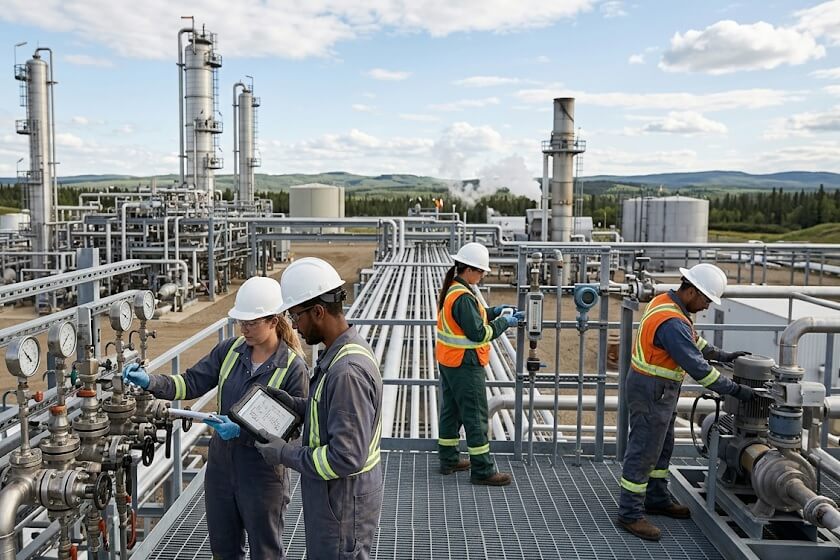
Methane reduction frameworks create operational demand across a wide network of Alberta businesses. Monitoring systems need installation and maintenance. Facilities require leak detection, retrofits, inspections, documentation, and technical reporting. Engineering support, instrumentation, compliance consulting, automation upgrades, and industrial maintenance all become part of the operational response.
These businesses are not usually visible in public conversations about regulation or emissions policy.
But they are often the businesses responsible for turning policy into workable reality.
In Calgary, professional service firms advising industrial clients may see stronger demand for compliance planning, reporting support, and operational strategy. In Edmonton, engineering and technical specialists may be drawn further into infrastructure upgrades and systems modernization. Across Grande Prairie and Medicine Hat, contractors and field-service businesses often find themselves supporting the practical implementation of standards clients are now more confident planning around.
This is one of Alberta’s quieter strengths.
The province has built a business ecosystem accustomed to operating in technically demanding environments. Alberta companies are used to balancing regulation, logistics, safety, reporting, and operational efficiency in industries where precision matters.
As a result, when rules become clearer, businesses are often able to respond quickly.
That responsiveness becomes increasingly valuable heading into 2026 and 2027.
After several years of inflation pressure, supply chain disruption, labour constraints, and shifting expectations, Alberta businesses are placing greater value on predictability. Businesses can usually adapt to new frameworks when they understand the path forward. What tends to slow growth is uncertainty layered on top of already complex operations.
This is why agreements like methane equivalency matter.
Not because they remove responsibility or operational demands, but because they reduce one layer of ambiguity.
A company considering facility upgrades can plan more confidently. A service provider can better forecast demand. A business evaluating staffing, training, or equipment investments can make decisions with slightly more visibility than before.
These are not dramatic changes.
But Alberta’s economy has often been shaped by exactly this kind of quiet operational adjustment. Businesses review a new framework, integrate what is required, and continue serving customers with minimal disruption. Over time, those small adjustments accumulate into something larger: resilience.
That may ultimately be the most practical significance of this agreement. Not simply methane policy. Not politics. But a clearer operating environment for Alberta businesses planning beyond the next quarter.
And in a province built on people who show up without applause, knowing where to find businesses that do the same still matters — and Alberta’s Best exists to embrace it.
Sources
- RBC Climate Action Institute – What the Canada-Alberta methane deal means for businesses
https://www.rbc.com/en/thought-leadership/climate-action-institute/energy-reports/what-the-canada-alberta-methane-deal-means-for-businesses/ - Government of Canada – Canada and Alberta reach agreement in principle on methane equivalency
https://www.pm.gc.ca/en/news/news-releases/2026/03/25/canada-and-alberta-reach-agreement-principle-methane-equivalency
