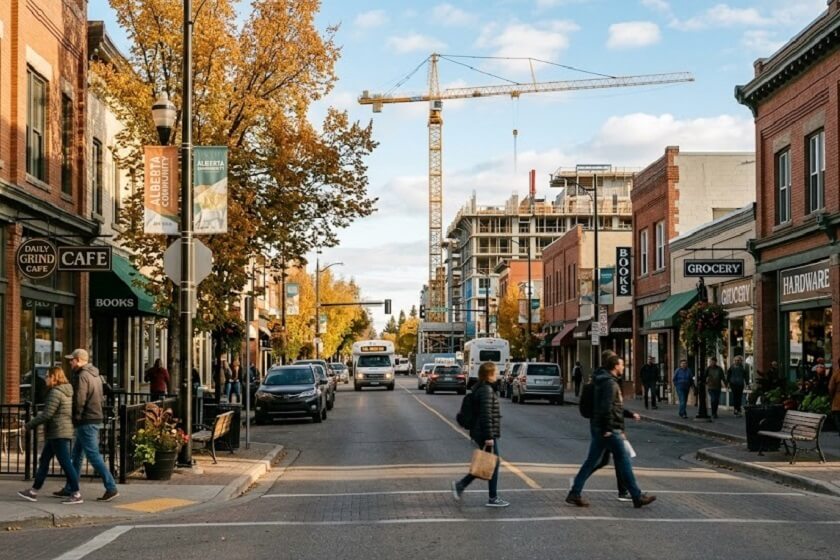
Alberta’s Economy Is Leading the Country. Here’s What That Looks Like
Alberta is projected to grow at 2.6% in 2026 — more than three times the national rate. Here’s what that actually means for businesses, families, and communities across the province.
The numbers came out this week and they aren’t subtle.
Alberta is projected to grow its economy by 2.6% in 2026 — more than three times the national rate of 0.8%. Retail sales are leading the country. Employment is rising. Population is still growing, even if the pace has slowed from the peaks of the past few years.
By almost every headline measure, Alberta is the strongest performing provincial economy in Canada right now.
And yet, if you talk to the owner of a mid-sized construction company in Calgary trying to figure out what the summer looks like, or a family in Edmonton watching their grocery bill and their mortgage renewal date at the same time, the picture feels more complicated than the top line suggests.
Both things are true. That’s what makes this moment worth paying attention to.
The Fast Car in the Slow Lane
ATB Financial’s chief economist Mark Parsons put it as plainly as an economist ever does.
“Alberta is moving like a fast car restricted to the slow lane. The momentum is clear, with Alberta leading in job gains and consumer activity. However, the trade conflict, ongoing cost of living pressures, and transportation infrastructure constraints are keeping the province from hitting top gear.”
That gap — between what Alberta’s economy could be doing and what it’s actually doing — is the real story underneath the growth forecast.
ATB’s December projection for 2026 was 2.1% growth. That number was revised upward to 2.6% largely because of what’s happening in the Middle East. The conflict in Iran and the closure of the Strait of Hormuz pushed oil prices significantly higher, lifting Alberta’s nominal GDP forecast by 8.8% for the year. WTI crude is now expected to average around US$84 per barrel in 2026 — a sharp jump from the US$61 figure ATB was working with six months ago.
Higher oil prices are good for Alberta’s revenue picture. What they haven’t done yet is unlock a new wave of energy investment. Producers are watching the situation carefully, holding capital discipline, and waiting to see whether the price environment is durable or temporary. The assumption built into most forecasts is that the Strait of Hormuz reopens in 2027 and prices retreat toward US$70. Nobody is building a twenty-year business plan around a geopolitical disruption.
What’s Actually Driving Growth
Strip out the oil price windfall and Alberta’s underlying economic story is still genuinely strong — it’s just being driven by different things than the province has historically relied on.
Population growth, even at a moderated pace, is translating directly into consumer activity. Alberta leads all provinces in retail sales growth, projected at 4.5% for the year. Employment is expected to grow 3.3%, with the unemployment rate declining to an annual average of 6.6%.
People are buying things, building things, and starting things. The construction sector is active. Professional services are busy. The data center investment story, the infrastructure buildout, the continued diversification into technology and logistics — all of it is adding layers to an economy that used to be far more dependent on a single commodity price.
That diversification doesn’t make headlines the way oil prices do. But it’s part of why Alberta’s growth story in 2026 has more foundation under it than some previous booms.
The Part the Numbers Don’t Capture
Here’s where it gets honest.
Parsons flagged it directly in the ATB report: “The top-line numbers tell a story of provincial economic resilience, but the day-to-day reality is that not everyone will feel the benefits.”
Youth unemployment remains above its historical norm. Cost of living pressures haven’t eased the way many households were hoping they would by now. Fuel and input costs are squeezing family budgets and business margins simultaneously. A small business owner in Red Deer trying to hire, manage rising supplier costs, and navigate uncertainty around the CUSMA trade review this summer is living in a different economic reality than the one the GDP forecast describes.
The CUSMA situation deserves a mention on its own. Alberta actually carries the lowest effective US tariff rate of any province — 1.5% of merchandise imports compared to a national average of 6.7% — which is a real advantage. But the review this summer introduces genuine uncertainty for businesses trying to plan beyond the next quarter. ATB’s base case assumes the existing exemptions hold. A breakdown of that assumption is identified as a key downside risk, and business hiring intentions are already showing the effect of that uncertainty.
What Pipeline Investment Could Add
There’s a number buried in the ATB report that doesn’t get enough attention.
If major pipeline expansions proceed — including the proposed new oil pipeline to the BC coast under the Canada-Alberta memorandum of understanding — combined with the Pathways carbon capture project, ATB’s modelling suggests those developments alone could add an average of 5.1% to Alberta’s real GDP between 2027 and 2035.
That’s not built into the base case forecast. It’s a possibility that depends on decisions and timelines that haven’t been confirmed. But it’s a significant number — and it points to how much upside Alberta’s economy still has if the infrastructure constraints that Parsons describes as restricting the fast car actually get resolved.
The slow lane problem is real. So is the potential waiting on the other side of it.
What It Means on the Ground
For Alberta businesses, the practical takeaway from this outlook is straightforward even if the economic picture is layered.
Demand is real and growing. Consumer activity is up. Population is still arriving. The province is attracting investment across multiple sectors simultaneously — energy, technology, construction, professional services. The businesses positioned to serve that demand, in the communities where it’s showing up, are in a genuinely good position heading into the second half of 2026.
The caution is equally real. Input costs are up. Labour markets are tighter than the unemployment rate alone suggests. Trade uncertainty hasn’t resolved. And the households driving that retail growth are also the households managing elevated mortgage costs and grocery bills that haven’t come down the way anyone hoped.
Alberta is leading the country. That’s not spin — it’s what the data shows.
It’s just that leading a slow national pack while your own engine is running at partial capacity is a specific kind of position. Better than the alternative. Not yet what it could be.
The fast car is still in the slow lane. But it’s moving.
Sources
- Alberta leads Canada growth outlook — Wealth Professional / ATB Financial https://www.wealthprofessional.ca/news/industry-news/alberta-leads-canada-growth-outlook/392709
